
What are the objectives of the Barbie marketing campaign?
- Nov 20, 2023
- 4 min read
Updated: Nov 26, 2023
‘Hi Barbie’ The film that took over the summer of 2023, directed by Greta Gerwig became the first live action Barbie film. With an impressive A-List cast including Margot Robbie and Ryan Gosling. The marketing campaign of this film was produced by Warner Brothers and had a variety of innovative promotional tools, throughout the research blogs they will aim to analyse the marketing campaign of the Barbie film.
When it comes to campaigns, the globally recognised brand of Barbie has always had the purpose to ‘inspire the limitless potential in every girl’ through representation and empowerment (Mattel, 2023). This was no different for the live action film which was largely focused on feminism through the discussions surrounding sexism and patriarchy which arguably the Barbie brand has always been accused of contributing to these issues. The Barbie film was also a humanist film that had the objective of showing the humanity of Barbie and Ken. Through interviews with director Greta Gerwig, it is valuable to conclude that there were many objectives for the film, but the primary ones were to honour the legacy of Barbie while still including culturally relevant conversations of how society is today (ABC News, 2023).

Fig 1, Margot Robbie as Barbie
In terms of the marketing strategy the main objectives were to create excitement and curiosity among consumers (Rubin,2023) while reinforcing the identity of the Barbie brand through nostalgia and rebranding the idea of the colour pink. After the initial promotional tools for Barbie were released, they instantly went viral on social media with many users creating memes and sharing their general excitement for the film (Rubin,2023).
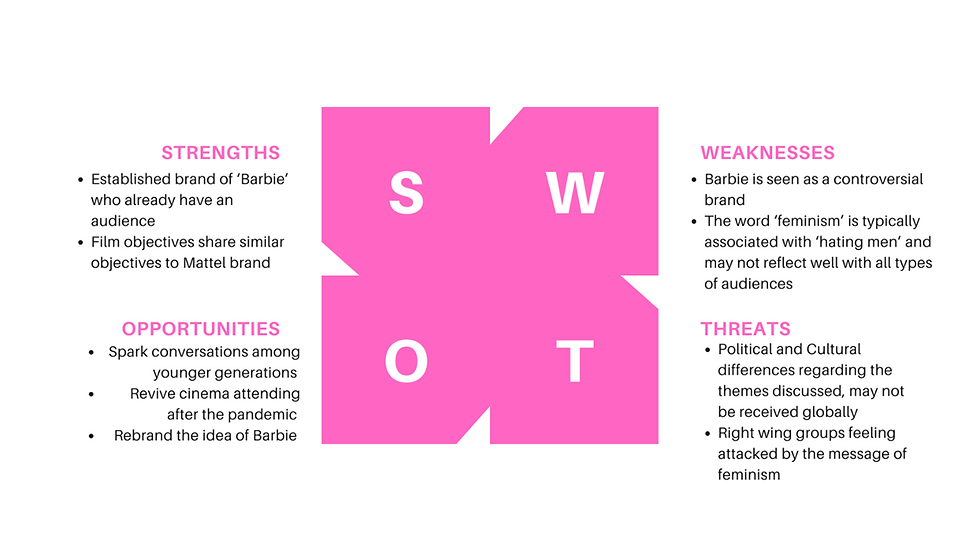
Fig 2, SWOT Analysis
Arguably, the themes within the film allows for an increased awareness of topics such as sexism, patriarchy and capitalism that is portrayed through a feminist lens that can create valuable conversations to be started among the younger generations. A Gen Z audience are more politically and culturally conscious who tend to engage in conversations surrounding racial and gender equality (Tyson,2021). Following this, Barbie is already an established global brand who have an audience, and this allows for the marketing strategy to target these audiences through the idea of nostalgia to entice consumers. The film’s objectives are like Mattel’s purpose of Barbie through empowerment with the discussion of feminism being present within the promotion of the film, representation through the diverse cast of actors in the type of Barbie they play such as President Barbie (played by Issa Rae).

Fig 3, Issa Rae as President Barbie
However, Barbie is seen to be a controversial brand that many people have negative connotations towards and with this the consumer may not respond to the primary objectives of the film as it is surrounded by serious topics. In addition to this, having feminism being associated with the film may not reflect well with certain audiences as feminism has typically been associated with ‘hating men’ rather than for gender equality (Scharff,2019). Following this, it may not reflect well globally due to there being countries where gender equality does not necessarily exist.
On the other hand, the objectives of the film can inspire and spark conversations among the younger generations, it also can revive cinema following the pandemic, while gaining earned media through brands wanting to be attached to the marketing strategy (Chaffey,2020). Additionally, it can have the opportunity to change the way Barbie is seen while still reinforcing the global identity. Furthermore, it raises the risk of the film in general being banned in certain countries due to political and cultural differences regarding the themes discussed, for example Right Wing groups framing the film to be an attack on masculinity through the message of female empowerment (Placido,2023).

Fig 4, I’m Just Ken Sequence
Reference List
ABC News In Depth (2023) Greta Gerwig and Margot Robbie discuss Barbie’s surprising feminism. YouTube. Available from: Greta Gerwig and Margot Robbie discuss Barbie's surprising feminism | 7.30 - YouTube (Accessed on: 28th October 2023)
Bramesco, C (2023) Barbie; the patriarchy, the existentialism, the capitalism. The Guardian. Available from: Barbie: the patriarchy, the existentialism, the capitalism – discuss with spoilers | Barbie | The Guardian (Accessed on 29th October 2023)
Chaffey, D (2020) Digital Marketing. Montreuil: Pearson.
Murphy, C (2023) A Complete History of the Barbie Movie. Vanity Fair. Available from: A Complete History of the Barbie Movie | Vanity Fair (Accessed on 29th October 2023)
Placido Di, D (2023) Here Are The Best Viral ‘Barbie’ Moments, From Malala to Clashing Kens. Forbes. Available from: Here Are The Best Viral 'Barbie' Moments, From Malala To Clashing Kens (forbes.com) (Accessed on: 29th October 2023)
Rubin, R (2023) Barbie Marketing Campaign Explained: How Warner Bros Promoted the Film. Variety. Available from: Barbie Marketing Campaign Explained: How Warner Bros Promoted the Film (variety.com) (Accessed on: 29th October 2023)
Scharff, C (2019) Why so many young women don’t call themselves feminist. BBC News. Available from: Why so many young women don't call themselves feminist - BBC News (Accessed on 29th October 2023)
Tyson, A (2021) Gen Z, Millennials Stand Out for Climate Change Activism, Social Media Engagement with Issue. Pew Research Center Available from: Gen Z, Millennials Stand Out for Climate Change Activism, Social Media Engagement With Issue | Pew Research Center (Accessed on: 29th October 2023)
Wiseman, E (2021) Margot Robbie’s Vogue 2021 Cover Interview. British Vogue. Available from: Read Margot Robbie's Vogue 2021 Cover Interview In Full: “If I Want Something, I Have To Make It Happen” | British Vogue (Accessed on 29th October 2023)


Comments